Best men’s cricketers of all time: 10 batters, bowlers and all-rounders
WicketPulse · Published
Updated
Who belongs in an all-time cricket discussion? Here are our ten batting, ten bowling and ten all-rounder selections from men’s international cricket, with the evidence behind each choice and the differences between eras kept in view.
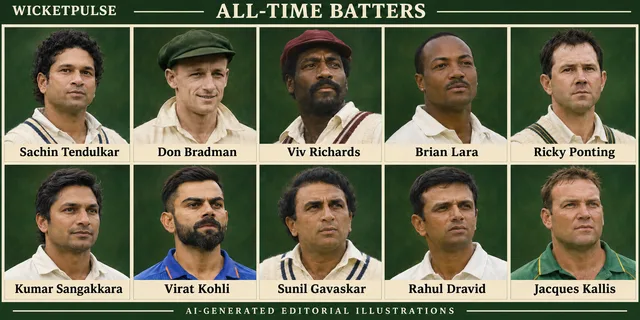
How these all-time selections were made
This is a WicketPulse editorial selection of men’s international cricketers, checked on 24 November 2026. Each category contains ten choices. The order is a presentation order, not an official ICC all-time ranking or a calculated league table.
We consider sustained output, peak performances, role, conditions and the formats available during a player’s era. Tests, ODIs and T20Is have different demands. Their averages are not combined, and franchise or other domestic statistics are excluded from the numerical anchors below.
Most figures are completed-career records from official profiles or retirement reports. Kohli’s 2023 World Cup and Shakib’s 2019 World Cup are explicitly dated selection examples, not current career totals. Rounded figures in an official profile remain rounded here. Hall of Fame membership supplies a source, not the selection order.
Our 10 all-time batting selections
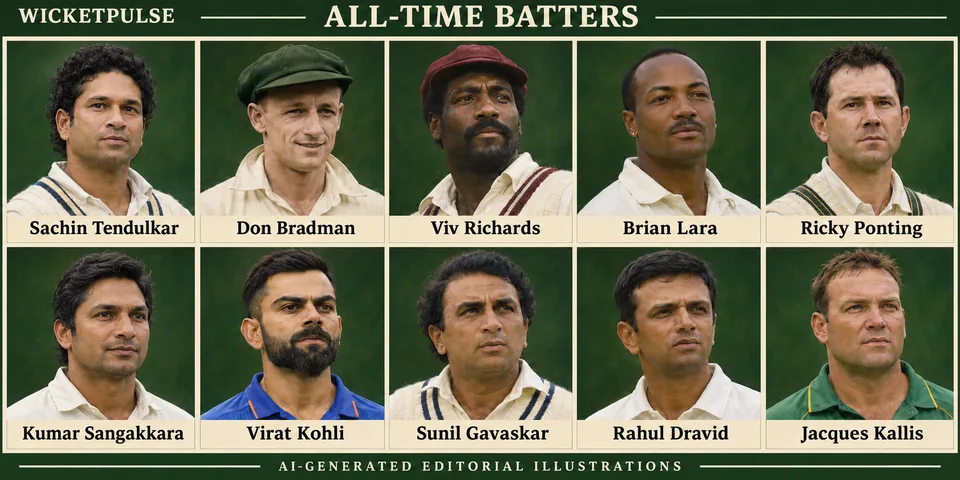
The batting selections cover sustained Test scoring, major one-day output, opening responsibilities and exceptional tournament peaks. Their roles and eras differ, so the table identifies the format and period behind each factual anchor.
Swipe the table horizontally to read all columns.
| Player | International team | Dated or completed-career evidence |
|---|---|---|
| Sachin Tendulkar | India | Tests: 15,921 runs; ODIs: 18,426 runs. ICC source |
| Don Bradman | Australia | Tests: 6,996 runs at an average of 99.94. ICC source |
| Viv Richards | West Indies | Tests: average 50.23; ODIs: strike rate 90.20. ICC source |
| Brian Lara | West Indies | Tests: 11,953 runs; highest innings 400 not out. ICC source |
| Ricky Ponting | Australia | Tests: 13,378 runs; ODIs: 13,704 runs. ICC source |
| Kumar Sangakkara | Sri Lanka | Tests: average 57.40 and 38 centuries. ICC source |
| Virat Kohli | India | 2023 men’s ODI World Cup: 765 runs at 95.62; reached his 50th ODI century during that tournament. ICC source (2023-11-19) |
| Sunil Gavaskar | India | Tests: 10,122 runs and 34 centuries. ICC source |
| Rahul Dravid | India | Tests: 13,288 runs; ODIs: 10,889 runs. ICC source |
| Jacques Kallis | South Africa | Tests: 13,289 runs at 55.37. ICC source |
Sachin Tendulkar
Tendulkar’s batting case stretches across 200 Tests and a vast ODI career. His 15,921 Test runs show sustained value in long innings; the 18,426 ODI runs demonstrate how much scoring he also carried in the shorter game. That combination of longevity and format adaptation makes him a central selection in this guide.
Don Bradman
Bradman turned 52 Tests into 29 centuries and 6,996 runs, finishing with an average of 99.94. The frequency of major innings gives his case an exceptional peak as well as a striking average. His selection recognises that Test achievement on its own terms, in an international career played before one-day cricket existed.
Viv Richards
Richards paired a Test average of 50.23 with an ODI strike rate of 90.20, a compelling blend of long-form output and scoring pressure. His 829 runs on the 1976 England tour give that reputation a concrete Test example. He represents attacking batting that could also sustain a demanding series-long performance.
Brian Lara
Lara’s unbeaten 400 against England in Antigua in 2004 captures his capacity to build an enormous innings. His wider record of 11,953 Test runs and 34 centuries shows the career surrounding that landmark. We select him for the combination of a remarkable scoring ceiling and repeated major contributions over a long international career.
Ricky Ponting
Ponting scored 13,378 Test runs and 13,704 ODI runs, making substantial contributions in both forms of the game. He also captained Australia’s World Cup-winning teams in 2003 and 2007. His selection brings together sustained batting production and experience leading a side through major one-day tournaments.
Kumar Sangakkara
Sangakkara’s Test average of 57.40, 38 centuries and 11 double-centuries show the scale of his long-form batting. Four consecutive ODI hundreds at the 2015 World Cup add a striking white-ball peak. Those achievements give his batting a strong case in its own right, alongside the wicketkeeping responsibilities he also carried.
Virat Kohli
Kohli scored 765 runs at 95.62 in the 2023 men’s ODI World Cup, passing fifty in nine of his eleven innings. His semi-final century was his 50th in ODIs at that time. That sustained tournament performance, including a major knockout innings, is the dated evidence behind his modern white-ball place here.
Sunil Gavaskar
Gavaskar was the first batter to reach 10,000 Test runs and finished with 10,122 and 34 centuries. His selection gives specialist opening batting a prominent place in the discussion. Facing the beginning of an innings is a distinct assignment, and his record shows how much scoring he produced from that demanding role.
Rahul Dravid
Dravid’s 233 and 72 not out in India’s Adelaide Test win in 2003 provide a vivid example of his match-shaping batting. The wider record—13,288 Test runs and 10,889 ODI runs—adds longevity and adaptability. We select him for that combination of substantial innings under pressure and sustained output across both formats.
Jacques Kallis
Kallis made 13,289 Test runs at 55.37 and scored 45 centuries in the format. Those are the foundations of his specialist batting selection: a long career of substantial innings and a high average. The batting case stands alongside, and separately from, the additional bowling contribution considered in our all-rounder section.
Our 10 all-time bowling selections
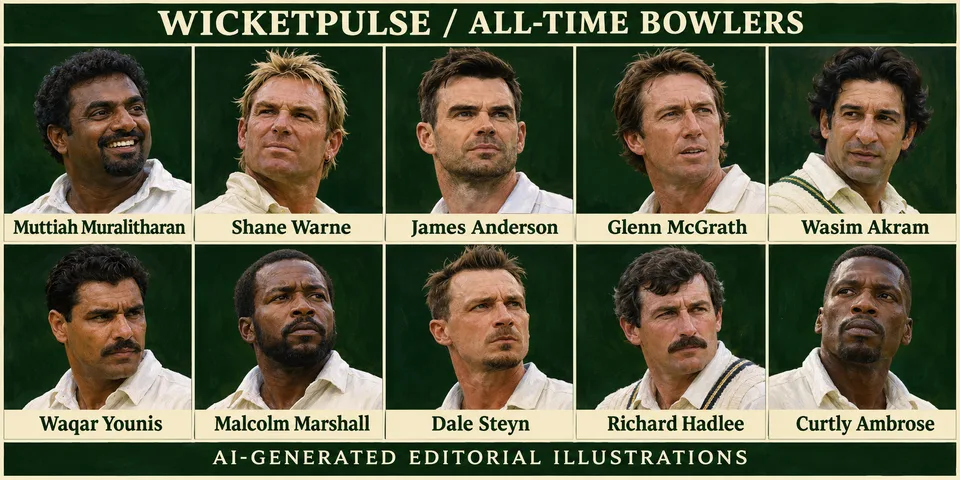
The bowling group combines spin, swing, seam and pace. Wicket totals are read alongside available averages, match counts and major performances. A bowling average is runs conceded per wicket; it is different from a bowling strike rate, which measures balls per wicket.
Swipe the table horizontally to read all columns.
| Player | International team | Dated or completed-career evidence |
|---|---|---|
| Muttiah Muralitharan | Sri Lanka | Tests: 800 wickets; ODIs: 534 wickets. ICC source |
| Shane Warne | Australia | Tests: 708 wickets; ODIs: 293 wickets. ICC source |
| James Anderson | England | Retired from international cricket in July 2024 with 704 wickets in 188 Tests. ICC source (2024-07-12) |
| Glenn McGrath | Australia | Tests: 563 wickets at 21.64. ICC source |
| Wasim Akram | Pakistan | Tests: 414 wickets; ODIs: 502 wickets. ICC source |
| Waqar Younis | Pakistan | Tests: 373 wickets; ODIs: 416 wickets. ICC source |
| Malcolm Marshall | West Indies | Tests: 376 wickets at 20.94. ICC source |
| Dale Steyn | South Africa | Tests: 439 wickets at 22.95. ICC source (2021-08-31) |
| Richard Hadlee | New Zealand | Tests: 431 wickets; 36 five-wicket hauls. ICC source |
| Curtly Ambrose | West Indies | Tests: 405 wickets at 20.99. ICC source |
Muttiah Muralitharan
Muralitharan finished with 800 Test wickets and 534 in ODIs. The two totals show sustained wicket-taking across long spells and limited-overs allocations. His selection recognises that breadth as well as the sheer volume of dismissals: he supplied a major bowling contribution in two formats with very different demands.
Shane Warne
Warne’s leg-spin brought variations to a career of 708 Test wickets and 293 ODI wickets. His Player of the Match award in the 1999 World Cup final adds a major limited-overs example. We select him for the combination of a long Test record and decisive performances on a world tournament stage.
James Anderson
Anderson completed his international career in July 2024 with 704 wickets from 188 Tests. Sustaining a fast-bowling career over 21 years required repeated returns to the demands of Test cricket. His selection recognises that extraordinary duration alongside the wicket-taking record documented at his final England appearance.
Glenn McGrath
McGrath’s 563 Test wickets came at an average of 21.64, combining a large tally with a low cost per dismissal. His control also contributed to Australia’s World Cup-winning campaigns in 1999, 2003 and 2007. That gives his selection strong evidence from both extended Test spells and tournament one-day cricket.
Wasim Akram
Wasim’s left-arm swing and seam bowling produced 414 Test wickets and 502 in ODIs. He offered a different angle of attack while sustaining a major international workload. The substantial returns in both formats are why he belongs here as an individual bowler, alongside the celebrated partnership he formed with Waqar Younis.
Waqar Younis
Waqar’s reverse swing and yorker were central to an attacking career that brought 373 Test wickets and 416 ODI wickets. His ODI best of 7/36 came against England at Leeds in 2001. The career totals and that destructive innings return explain his place among our wicket-taking pace selections.
Malcolm Marshall
Marshall took 376 wickets in 81 Tests at an average of 20.94 and a bowling strike rate of 46.7. Those figures combine frequent dismissals with a low run cost. They give his selection a strong efficiency-based case alongside bowlers whose longer careers produced larger overall wicket totals.
Dale Steyn
Steyn’s completed Test record contains 439 wickets in 93 matches at 22.95. His international career also brought 196 ODI wickets and 64 in T20Is. We select him for a substantial Test pace-bowling record supported by contributions in both white-ball formats, with the figures taken from the dated retirement report.
Richard Hadlee
Hadlee was the first bowler to reach 400 Test wickets and finished with 431 at 22.29. His 36 five-wicket hauls show how often he took a substantial share of an innings. That repeated ability to lead a Test attack is the specialist bowling foundation of his selection.
Curtly Ambrose
Ambrose finished with 405 Test wickets at 20.99 and also took 225 wickets in ODIs. The average gives a measure of how little his Test dismissals cost across the career. We select him for that combination of substantial wicket-taking, run control and an international record extending into the one-day game.
Our 10 all-time all-rounder selections
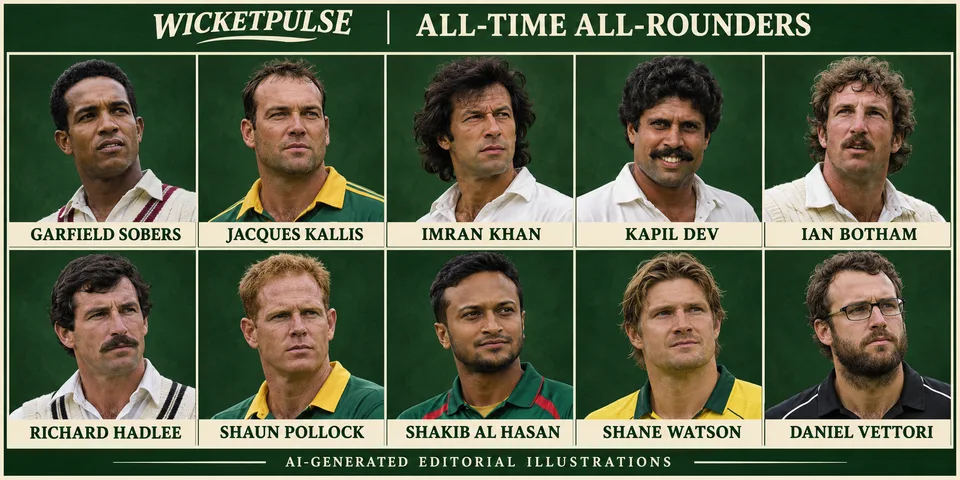
These players contributed meaningfully with both bat and ball. Some had a batting-led role, others a bowling-led role; versatility does not require equal strength in each discipline. Kallis and Hadlee also appear in a specialist category, for separately explained reasons.
Swipe the table horizontally to read all columns.
| Player | International team | Dated or completed-career evidence |
|---|---|---|
| Garry Sobers | West Indies | Tests: 8,032 runs and 235 wickets. ICC source |
| Jacques Kallis | South Africa | Across internationals: 25,534 runs and 577 wickets. ICC source |
| Imran Khan | Pakistan | Tests: 362 wickets; batting average 37.69. ICC source |
| Kapil Dev | India | Tests: 5,248 runs and 434 wickets. ICC source |
| Ian Botham | England | Tests: 5,200 runs and 383 wickets. ICC source |
| Richard Hadlee | New Zealand | Tests: 3,124 runs and 431 wickets. ICC source |
| Shaun Pollock | South Africa | 421 Test wickets and 393 ODI wickets; more than 7,000 international runs. ICC source |
| Shakib Al Hasan | Bangladesh | 2019 men’s ODI World Cup: 606 runs and 11 wickets. ICC source (2019-07-07) |
| Shane Watson | Australia | ODIs: 5,757 runs and 168 wickets; 2012 T20 World Cup: 249 runs and 11 wickets. ICC source (2020-11-03) |
| Daniel Vettori | New Zealand | ICC career profile: more than 700 international wickets and close to 7,000 international runs. ICC source |
Garry Sobers
Sobers scored 8,032 Test runs at 57.78 and took 235 wickets, bowling medium pace as well as finger and wrist spin. His range of bowling options sits beside the record of a major specialist batter. That combination makes versatility, rather than a single narrow role, the centre of his all-rounder case.
Jacques Kallis
Kallis combined 25,534 international runs with 577 wickets across formats. That scale of contribution in both disciplines gives his all-rounder case unusual depth. He could shoulder a major batting role while also providing a substantial bowling option, which is a different selection argument from the specialist batting record discussed above.
Imran Khan
Imran took 362 Test wickets at 22.81 while averaging 37.69 with the bat. Both disciplines therefore supply a clear foundation for his selection. Captaining Pakistan to the 1992 World Cup adds another important part of his cricketing record, alongside the Test batting and bowling that define his all-round contribution.
Kapil Dev
Kapil’s 5,248 Test runs and 434 wickets show substantial contributions as a batter and frontline pace bowler. His unbeaten 175 against Zimbabwe during India’s victorious 1983 World Cup campaign supplies a major one-day batting example. We select him for that breadth of responsibility across a long international career.
Ian Botham
Botham’s influence in the 1981 Ashes is a celebrated example of an all-rounder shaping a series. His completed Test record adds the broader foundation: 5,200 runs, 14 centuries and 383 wickets. The selection values the capacity to make major contributions in either discipline, backed by a substantial career in both.
Richard Hadlee
Hadlee added 3,124 Test runs to his 431 wickets, giving New Zealand batting value alongside his leading bowling role. His all-round balance was clearly bowling-led. The selection recognises the useful extra dimension supplied by his batting while preserving the distinction between this role and his specialist bowling place.
Shaun Pollock
Pollock took 421 Test wickets and 393 ODI wickets while also scoring more than 7,000 international runs. His all-round role was built around frontline bowling with substantial batting support. That model deserves a place beside batting-led all-rounders because it adds a second useful skill without diminishing the primary responsibility.
Shakib Al Hasan
Shakib scored 606 runs and took 11 wickets at the 2019 men’s ODI World Cup, averaging 86.57 with the bat. That campaign shows batting and bowling value delivered together in the same tournament. It is the clearly dated peak behind his selection here, with both disciplines carrying a significant share of Bangladesh’s workload.
Shane Watson
Watson’s completed ODI career brought 5,757 runs and 168 wickets. At the 2012 T20 World Cup he added 249 runs and 11 wickets and was named Player of the Tournament. His unbeaten 105 in the 2009 Champions Trophy final is another major white-ball contribution, supporting a selection built around batting power and useful seam bowling.
Daniel Vettori
Vettori combined left-arm orthodox spin with batting support through a long New Zealand career. The ICC profile records more than 700 international wickets and close to 7,000 runs, retaining rounded figures here. His selection gives spin-bowling all-rounders representation alongside the pace-bowling models that feature strongly in this group.
Reading an all-time cricket list across eras
An all-time list changes when the question changes. A Test-only selection, a T20I-only selection, a women’s international guide or a list built around a particular playing XI would need a different method and could produce different names. This page does not claim to settle those separate debates.
The tables provide evidence for inclusion, not a formula proving that the next player outside a list was inferior. Earlier eras offered fewer international formats, while later careers faced different schedules and specialisation. These differences are part of the judgment.
Current weekly ICC rankings answer a different question from historical editorial selection. The source profiles are used for factual career figures and dated achievements; old comparative statements such as a player being second or fourth on a live all-time table have not been carried forward.
A separate dated Women’s T20I rankings update · Batting statistics guide · Available scores and fixtures
Sources
- ICC: Sachin Tendulkar — Hall of Fame career profile
- ICC: Don Bradman — Hall of Fame career profile
- ICC: Viv Richards — Hall of Fame career profile
- ICC: Brian Lara — Hall of Fame career profile
- ICC: Ricky Ponting — Hall of Fame career profile
- ICC: Kumar Sangakkara — Hall of Fame career profile
- ICC: Virat Kohli — 2023-11-19
- ICC: Sunil Gavaskar — Hall of Fame career profile
- ICC: Rahul Dravid — Hall of Fame career profile
- ICC: Jacques Kallis — Hall of Fame career profile
- ICC: Muttiah Muralitharan — Hall of Fame career profile
- ICC: Shane Warne — Hall of Fame career profile
- ICC: James Anderson — 2024-07-12
- ICC: Glenn McGrath — Hall of Fame career profile
- ICC: Wasim Akram — Hall of Fame career profile
- ICC: Waqar Younis — Hall of Fame career profile
- ICC: Malcolm Marshall — Hall of Fame career profile
- ICC: Dale Steyn — 2021-08-31
- ICC: Richard Hadlee — Hall of Fame career profile
- ICC: Curtly Ambrose — Hall of Fame career profile
- ICC: Garry Sobers — Hall of Fame career profile
- ICC: Imran Khan — Hall of Fame career profile
- ICC: Kapil Dev — Hall of Fame career profile
- ICC: Ian Botham — Hall of Fame career profile
- ICC: Shaun Pollock — Hall of Fame career profile
- ICC: Shakib Al Hasan — 2019-07-07
- ICC: Shane Watson — 2020-11-03
- ICC: Daniel Vettori — Hall of Fame career profile