Batting strike rate: why averaging two innings can give the wrong answer
WicketPulse · Published
Updated
Two batters can both have a strike rate of 150 after very different innings. Two innings with rates of 200 and 100 do not necessarily combine to 150. The missing information is the number of balls behind each rate. This guide shows the arithmetic with invented examples, so every number can be checked without treating a real player’s performance as a verdict.
Start with batter runs and balls faced
Batting strike rate means runs per 100 balls faced: divide the batter’s runs by the recorded balls faced, then multiply by 100. An archived ICC report uses that unit explicitly. We cite it for the meaning of the statistic, not for current player figures.
Use runs and balls from the same batter and innings. Team totals, overs and a delivery count guessed from the match clock are different inputs. If balls faced are unavailable, leave the calculation unavailable. Zero balls is also a boundary: dividing by zero does not produce a meaningful batting rate.
For example, 18 runs from 12 balls gives 18 ÷ 12 × 100 = 150.00. Calculate from the counts first and round only the displayed result.
Equal rates do not mean equal contributions
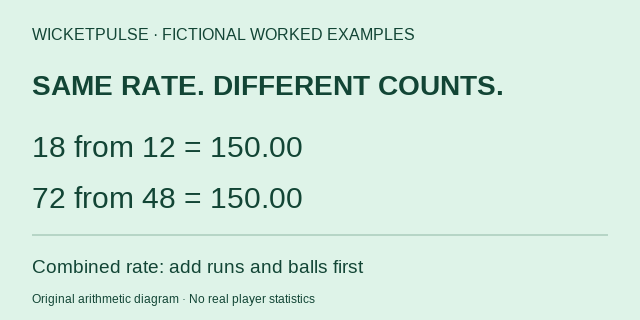
Both innings score at the same rate, but B includes four times the runs and four times the balls. The rate describes scoring pace across the recorded innings; it does not establish equal match impact, difficulty or future ability.
A useful conclusion keeps the counts visible: A made 18 from 12 and B made 72 from 48, both at 150. A claim that one batter was more valuable would require match context that this invented table does not contain.
| Fictional innings | Runs | Balls | Strike rate |
|---|---|---|---|
| A | 18 | 12 | 150.00 |
| B | 72 | 48 | 150.00 |
One dot ball changes a short innings more
Keep the runs unchanged and add one dot ball to each example. A’s displayed rate falls by 11.54 points, while B’s falls by 3.06 points. The same extra ball has a larger effect on the shorter innings.
This is a sensitivity exercise, not a prediction. It does not estimate a player’s ability or say what the next delivery will bring. It explains why an eye-catching rate from a short appearance can change quickly.
| Fictional innings after one extra dot | Runs | Balls | New rate |
|---|---|---|---|
| A | 18 | 13 | 138.46 |
| B | 72 | 49 | 146.94 |
Combine the counts before calculating the rate
The simple average of 200 and 100 is 150. That calculation gives a four-ball innings the same influence as a 40-ball innings. It therefore answers a different question from the combined batting rate.
Add the actual counts instead: 8 + 40 = 48 runs and 4 + 40 = 44 balls. Then 48 ÷ 44 × 100 = 109.09 after rounding. The longer innings contributes more balls to the denominator.
As a check, weighting the exact innings rates by balls gives (200 × 4 + 100 × 40) ÷ 44, also 109.09. Using original runs and balls is preferable when scorecards display rounded rates.
| Fictional record | Runs | Balls | Strike rate |
|---|---|---|---|
| Innings C | 8 | 4 | 200.00 |
| Innings D | 40 | 40 | 100.00 |
| Combined | 48 | 44 | 109.09 |
Keep a repeatable comparison record
Before comparing players, define the format, competition and date range. Include the innings that meet that rule rather than changing the sample after seeing the result. Keep the match identifier, batter, runs, balls faced and source scorecard beside each row.
For a match in progress, record when you observed the figures and whether the innings was final. The time a website retrieved data is not necessarily the time of its latest scoring event. Recheck a live entry before presenting it as a completed innings.
Finally, write what your comparison measures and what remains unknown. Strike rate alone cannot reveal pitch difficulty, bowling quality or chase pressure. Those are separate questions needing separate evidence. Retaining the underlying counts lets another reader reproduce the narrower claim.