How net run rate is calculated in cricket: worked examples and common mistakes
WicketPulse · Published
Net run rate compares the speed at which a team scores with the speed at which its opponents score across the relevant competition stage. To calculate it, divide the team's total credited runs by its total credited overs, then subtract the equivalent runs-per-over figure for its opponents. The result is a rate difference, not a total of winning margins.
Start with one uncomplicated match
Consider a hypothetical T20 match with no rain adjustment. Team A scores 180 in 20 overs and holds Team B to 160 in 20. Team A's scoring rate is 180 ÷ 20 = 9.00. Its conceding rate is 160 ÷ 20 = 8.00. Its NRR for that single match is therefore +1.00; Team B's is −1.00.
That example uses complete innings of equal length. Chases require more care because the winner may not use its whole allocation.
Convert incomplete overs into balls
Suppose Team A makes 150 in 20 overs and Team B wins with 151 in 18.3 overs, without being all out. The notation 18.3 means 18 overs and three legal balls: 111 balls, or 18.5 mathematical overs.
Team B's rate is 151 × 6 ÷ 111 = 8.1622. Team A's rate is 7.50. Team B's single-match NRR is approximately +0.662, not the figure produced by dividing 151 by the decimal 18.3. Keep full precision while calculating and round only the final display.
Combine the totals, not the match rates
Now give hypothetical Team A two matches. In the first, it scores 180 in 20 overs and concedes 160 in 20. In the second, it scores 151 in 18.3 overs while chasing an opponent's 150 in 20.
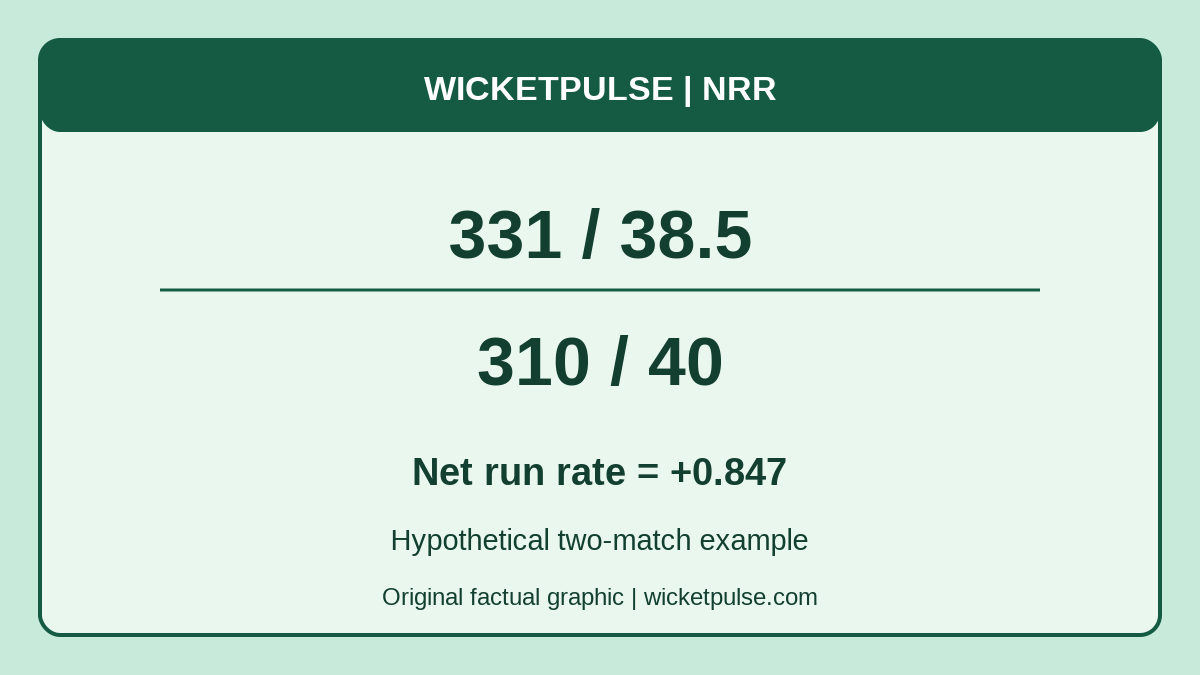
Its combined scoring figures are 331 runs from 231 balls, or 38.5 overs: 8.5974 runs per over. Its opponents have 310 from 40 overs: 7.75 per over. Team A's combined NRR is about +0.847. Simply averaging its two match NRR figures would give a different answer because the batting denominators differ.
Why being all out changes the denominator
Under the ICC Men's T20 World Cup 2026 conditions, a side dismissed before its allocation is charged that full allocation for NRR. A hypothetical 100 all out in 15 overs of a 20-over innings therefore uses 20 overs, giving 5.00 rather than 6.67. A successful chase that finishes early without an all-out innings uses the overs actually faced.
The same conditions exclude Super Overs and no-result matches from this calculation. Rain-adjusted results have specific DLS credits; do not calculate those by blindly inserting the original first-innings score. Always check the rules of the actual event, since NRR is a competition regulation, not a universal table-order rule.
A useful checking method
For ordinary completed matches, build four columns: credited runs scored, credited balls faced, runs conceded and credited balls bowled. Sum each column, calculate both rates and subtract. Separately flag all-out innings and rain-adjusted matches before trusting the total. That small check catches the two biggest arithmetic traps: treating overs as decimals and averaging match rates.