Retired hurt vs retired out: can a batter return to bat?
WicketPulse · Published
Updated
A batter leaving the field has not necessarily been dismissed. Retired hurt and retired out describe different situations, and the rules governing a return depend on the competition. Start with the official scorecard and the playing conditions rather than treating every retirement as a wicket.
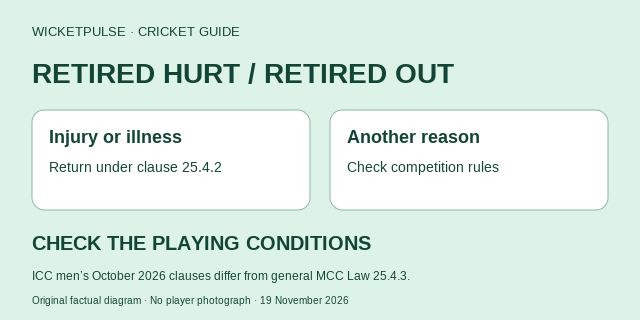
Retiring because of injury, illness or unavoidable cause
Under clause25.4.2 of the ICC men's ODI conditions effective October2026, a batter who retires through injury, illness or another unavoidable cause is entitled to resume the innings. If the innings is not resumed, the prescribed record is Retired - not out. Retirement must occur while the ball is dead, and the umpires must be told the reason before play continues.
When can the batter resume?
The timing of a return matters too. The current men's T20I conditions permit resumption under 25.4.2 at the fall of a wicket or when another batter retires. This is a right within the playing rules, not a statement that a particular injured player is medically ready or will return.
Another reason under the checked ICC conditions
For another reason, clause25.4.3 of the current men's WTC conditions specifies Retired - out. Its return clause refers only to 25.4.2. The checked men's ODI and T20I documents use the same distinction: they do not include the opposing-captain-consent route found in the general MCC law. Do not promise that a tactical retirement can be reversed by getting the other captain's agreement in these internationals.
Why MCC law can give a different answer
MCC Law 25.4.3, in the 2026 edition, has a different general provision. For retirement outside illness, injury or another unavoidable cause, resumption requires the opposing captain's consent. If the innings is not resumed, it is recorded as retired out. That general-law wording must not be substituted for a competition's specific conditions.
| Situation | Checked ICC men's ODI/T20I/WTC rule | Return |
|---|---|---|
| Injury, illness or unavoidable cause | Retired - not out if innings not resumed | Permitted under 25.4.2 at a wicket or another retirement |
| Other reason | Retired - out | No MCC captain-consent route in the checked clauses |
| General MCC law only | Different 25.4.3 provision | Opponent captain consent required for other reasons |
A fictional scoring example: 24 plus 11 is 35
Illustrative example, not a real match: Batter A leaves injured on 24. A later legal return continues that same innings; scoring another 11 makes 35, rather than a separate 11-run innings. If A cannot return, the not-out retirement label remains. Batter B leaves for a tactical reason on 24 in a match using the checked ICC conditions; use the retired-out classification instead. No bowler should be invented in either retirement entry.
Read the entry with its competition context
Before reading a retirement entry, check three things: why the batter left, whether the innings resumed, and which competition rules apply. The label does not establish a diagnosis or future selection availability. This guide concerns retirement during an innings; it does not mean retirement from a playing career. Other tournaments and later editions require their own conditions check.