The follow-on in Test cricket: the 200-run rule, captain's choice and rain exception
WicketPulse · Published
A follow-on allows the team that batted first to make its opponent bat again immediately after the opponent's first innings. In an ordinary five-day Test, the first-batting team needs a first-innings lead of at least 200 runs to have that option. Eligibility does not make enforcement compulsory.
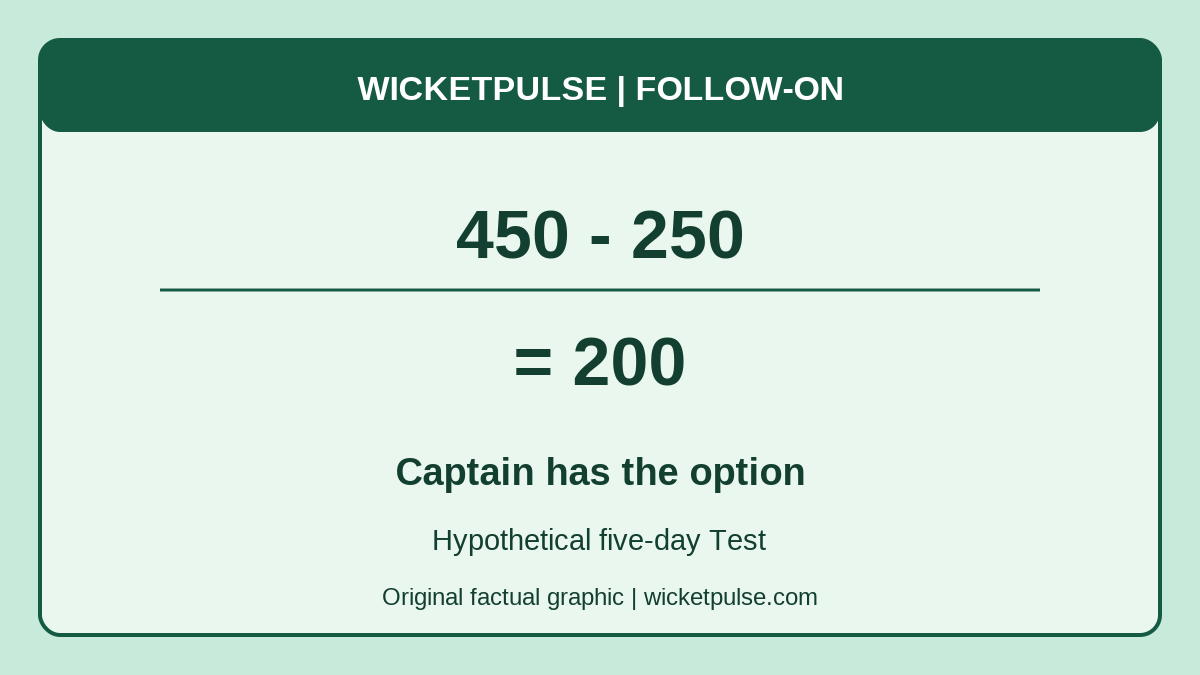
Calculate the threshold from the first-innings totals
Suppose hypothetical Team A scores 450. If Team B completes its first innings on 250, the gap is exactly 200 and Team A can enforce the follow-on. If Team B makes 251, the gap is 199 and the normal five-day threshold has not been met.
A quick way to describe the same situation is that Team B needs 251 to avoid being liable to follow on. It does not need to match 450. The follow-on threshold and the score needed to take a lead are separate targets.
Two possible innings orders
Without a follow-on, a normal sequence is A first innings, B first innings, A second innings, B second innings. Enforcing it changes the middle: A first innings, B first innings, B second innings, then A's second innings if needed.
For example, with A on 450 and B on 250, imagine B follows on and makes 300. B's combined 550 exceeds A's 450 by 100, leaving A a target of 101. If B instead makes only 180 in its second innings, its combined 430 remains 20 short of A's first innings: A wins by an innings and 20 runs. These are teaching examples, not match reports.
Why a captain might choose to bat again
The decision involves more than arithmetic. Bowling workload, time remaining and the preference to set a fourth-innings target can all be relevant considerations. A captain may prefer to give the bowlers a break; another may judge that immediate pressure is the better opportunity. Those are possible strategic reasons, not proof of why a particular captain acted.
The applicable conditions require the captain to notify the opponents and umpires when taking the follow-on option; once notified, that decision cannot be changed. Readers should wait for the official announcement rather than treating a 200-run lead as an automatic change of innings order.
What if the first day has no play?
The rule has a specific provision for a completely lost opening day. Eligibility is then based on the days remaining when play first begins. The shorter-match thresholds are 150 for three or four days, 100 for two and 75 for one.
For example, if a scheduled five-day match has no play at all on Day 1 and begins on Day 2 with four days remaining, the threshold is 150. This is not a rule that automatically reduces the threshold whenever rain removes some overs. The distinction is whether play took place on the opening day; the starting day counts as a whole day even if play begins late.
When checking a real match, establish the governing conditions, first-innings totals, opening-day status and captain's decision. The lead alone answers only one part of the question.